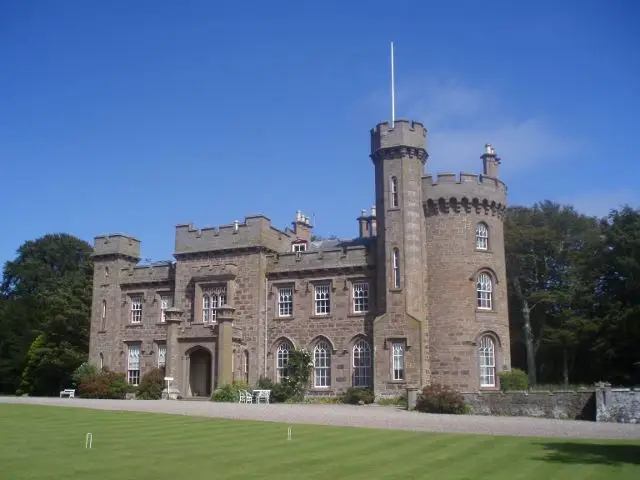
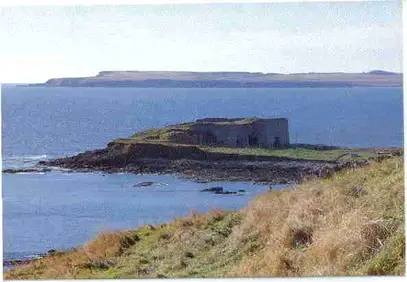
Dunninald has a history of at least a thousand years. The name derives from the Gaelic — Dùnan, meaning a little fort or hillock , and àrd, meaning a crag. This is a good description of the original site, which stood on a cliff above the sea.
The first Dunninald is now known as Black Jack, and the origin of the name is uncertain. One possibility is that when ships entered the harbour at the Boddin, a black flag flew from the castle ruins as a navigational marker.
Around 1590 a second house was built some four hundred yards inland. Little remains but the well, parts of the walled garden and some ruins in the wood.
By 1811 the second house was over two hundred years old. The new owner, Peter Arkley, commissioned the architect James Gillespie Graham to design a replacement. Built in the Gothic Revival style, construction began in 1819 and was completed in 1824.
Gillespie Graham was one of Scotland’s foremost architects of the early nineteenth century. He worked extensively in the Gothic Revival style across houses and churches throughout the country. Works include the Glenfinnan Monument, cathedrals in Edinburgh and Glasgow, and the Edinburgh Festival venue known as The Hub.
Two of his major country house commissions are now ruins: Armadale Castle on Skye and Cambusnethan Priory near Glasgow.
Dunninald, by contrast, is little altered since the day it was completed. This is the main reason the house is held in such high regard.
Among his draftsmen was Augustus Pugin — who went on to design the interior of the Houses of Parliament.
The house is long associated with the sea. It is only half a mile from the site of the first Dunninald (Black Jack) and the old lime kiln at Boddin Point.
The Boddin forms the northern headland of Lunan Bay, with the ruins of Red Castle at its centre, and the Bell Rock Lighthouse, 15 miles out to sea.
In the days of Black Jack, salmon nets were a hazard for ships entering the harbour below the castle. They are still sometimes seen in the water between June and August.